REVIEW · NEW DELHI
Delhi Day Tours with Lunch, Monument Entrance and Rickshaw Ride
Book on Viator →Operated by Freedom Journey India · Bookable on Viator
Delhi can feel like a moving target. This 8-hour small-group loop strings together Qutub Minar, Humayun’s Tomb, Old Delhi’s mosques and markets, plus a rickshaw ride, with lunch and entrance fees handled. I especially like the tight group size (15 or fewer) and the guide’s clear commentary that helps you connect the dots as you go. The main catch to watch is that the schedule flags Monday by-passes for at least two major stops, so your exact route may vary.
I also like the no-nonsense logistics: round-trip hotel pickup and transportation mean you can skip map panic and taxi bargaining in a city this spread out. This is a full day with several sights, so the tempo is brisk, and you’ll want to plan your energy for walking, stairs, and short transitions.
In This Review
- Key takeaways before you go
- The day’s flow: Old and New Delhi in one managed loop
- Hotel pickup and small-group size that keeps the day readable
- Qutub Minar: a tall landmark and the 13th-century story
- Lotus Temple on Monday: what the schedule by-pass really means
- Humayun’s Tomb: Mughal-era design in a longer 90-minute visit
- Parliament House and Rashtrapati Bhavan: Lutyens and Baker’s imprint
- India Gate: a memorial with a clear, guided meaning
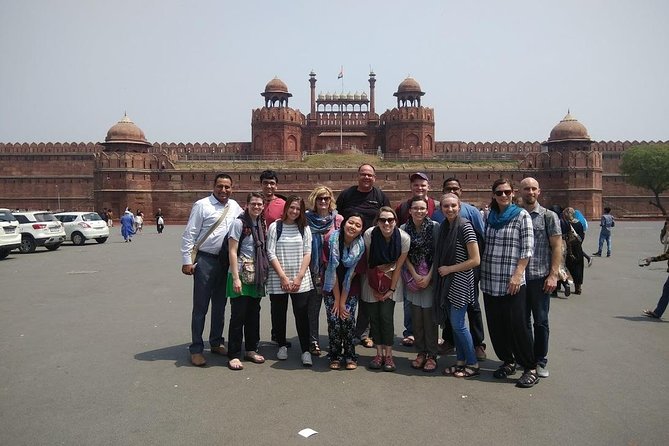
- Red Fort on Monday: another major stop that may be skipped
- Jama Masjid and the courtyard scale you can feel
- Chandni Chowk via Pasar Chandni Chowk: where the day gets edible
- Raj Ghat: a short, meaningful break after the market noise
- Lunch and entrances included: why $25 can feel like a deal
- Rickshaw ride in Old Delhi: small time investment, big day payoff
- Who should book this Delhi loop, and who should skip it
- Should you book Delhi Day Tours with Lunch, Monument Entrance and Rickshaw Ride?
- FAQ
- How long is the tour, and what time does it start?
- Does the price include lunch?
- Is pickup and transportation provided?
- What entrance fees are included?
- Is there a rickshaw ride?
- How big is the group?
- Can I cancel for a full refund?
Key takeaways before you go

- Small group, big clarity: up to 15 people, with navigation and sight-by-sight commentary included
- Lunch and monument entrances covered: including sites such as Qutub Minar, Humayun’s Tomb, the Red Fort, and India Gate (with one key exception noted below)
- Old Delhi gets real time: includes a rickshaw ride plus time at Chandni Chowk for food-shop browsing
- A strong Mughal-to-Imperial mix: Mughal monuments plus Lutyens and Baker capital-era architecture stops
- Mobile ticket for smoother entry: confirmation and a mobile ticket help reduce friction at busy sites
The day’s flow: Old and New Delhi in one managed loop
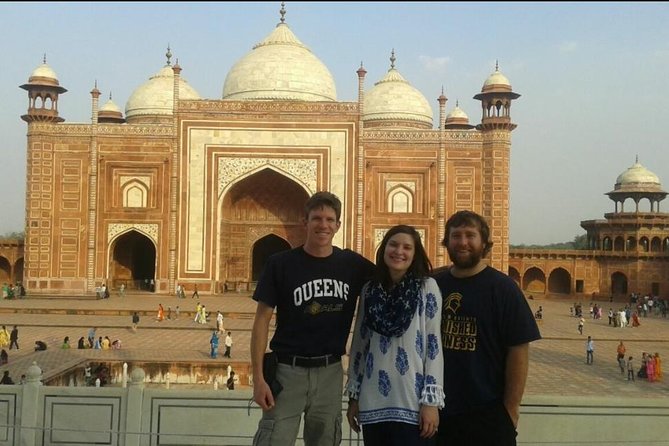
This tour is built for people who want to see a lot without turning the day into a puzzle. You start with a major south-Delhi landmark (Qutub Minar), then move into Mughal-era highlights around Humayun’s Tomb. After that, you shift toward the grand memorial and government buildings area in New Delhi, before you head into Old Delhi for mosques, a historic market, and the rickshaw ride.
The value is how much decision-making this removes. You don’t have to figure out which taxi to take, which ticket counter to find, or how to sequence stops across Delhi’s traffic and sprawl. The tradeoff is that you’re on a fixed rhythm, so this isn’t the best fit if you want a slow, wandering day with lots of free time.
You can also read our reviews of more tours and experiences in New Delhi



Hotel pickup and small-group size that keeps the day readable
Pickup is included, and transportation is arranged round-trip from your hotel. That matters in Delhi because travel time can be unpredictable, and getting stuck between sights usually steals the best part of the day: your attention.
Your group is listed as 15 people or fewer, and there are vehicle options depending on how many people you have:
- 1–3 people: Dzire car
- 4–5 people: Innova or Ertiga
- 6–9 people: Tempo Traveler (9-seater)
- 10–15 people: Tempo Traveler (15-seater)
You’ll also be traveling with an English-speaking tour guide and a mobile ticket, which helps at sites where entry lines can get confusing.
Practical takeaway: if you like asking questions and getting straight answers, a smaller group makes that easier. If you prefer a very private, zero-schedule day, this one is still “private to your group,” but it stays structured.
Qutub Minar: a tall landmark and the 13th-century story
Your first stop is Qutub Minar, with about 30 minutes on the ground and admission included. The tour description frames it as the tallest structure on the Mughal dynasty axis, associated with Allauddin Khilji in the 13th century, and notes it has a tower up to five levels.
Even if you don’t climb anything, the scale hits fast. Qutub Minar’s power is visual: you’re looking at a landmark meant to last, built when Delhi’s power and style were shifting. With a guide’s narration in your ear, you’re not just snapping photos—you’re learning what to notice: the monument’s role, its era, and why it became a kind of reference point for later architecture.
Watch your time here: the stop is shorter by design. Use it to get your bearings, take your main photos, and don’t plan on deep reading inside the complex unless your group timing allows it.
Lotus Temple on Monday: what the schedule by-pass really means
Next comes Lotus Temple, with 20 minutes and admission included. The description highlights the “27 kinds of marble petals” that form clusters to look like lotus, and it frames the concept as one space for all religions.
There’s an important schedule note: MONDAY ONLY BY PASS is marked for Lotus Temple. In plain terms, on Mondays you should assume you may not stop here, even though it’s part of the usual routing.
If you do visit, this stop is a good contrast to the more fortress-like feeling of other sights. It’s a calmer moment where the architecture is the main event, and the guide’s explanation helps you understand why it’s meant to feel inclusive.
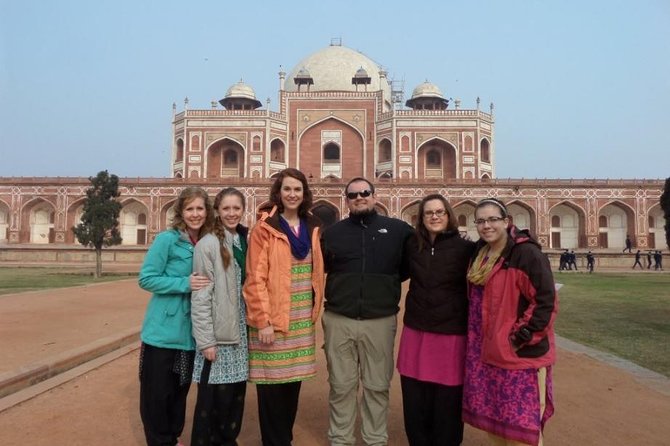
Humayun’s Tomb: Mughal-era design in a longer 90-minute visit
Humayun’s Tomb is one of the longer stops at 1 hour 30 minutes, with admission included. The tour description credits Haji Begun as the wife of a Mughal emperor and places the tomb in the 16th century, calling out Mughal characteristics.
This is where you get more time to slow down. A guided visit here works because the monument rewards attention: proportions, layouts, and how the setting supports the architecture. A shorter stop can turn this into a photo sprint. With 90 minutes, you’re more likely to actually understand what you’re looking at.
Good to know: Humayun’s Tomb is both a monument and a lesson in how Mughal design carried ideas forward. If you’re the type who likes learning the “why” behind what you see, don’t treat this as a quick stop.






Parliament House and Rashtrapati Bhavan: Lutyens and Baker’s imprint

Your itinerary includes Sansad Bhavan (Parliament House) and Rashtrapati Bhavan. These aren’t described with a specific time in the provided outline, but they’re clearly part of the New Delhi segment.
- Sansad Bhavan is noted as being built and designed by British architects Sir Edwin Lutyens and Sir Herbert Baker in 1912.
- Rashtrapati Bhavan is also attributed to Lutyens and Baker and is described as the former Viceroy’s House, up until 1950.
What you get from including these buildings is context. Delhi isn’t just temples and forts. It also has a government-city identity shaped during the British period and then repurposed for independent India. Even a brief look helps your day feel like one story instead of random stops.
Practical expectation: don’t plan for a long deep-dive here unless your guide’s timing allows it. The tour’s big time commitments are Qutub Minar, Humayun’s Tomb, Red Fort, and Jama Masjid.
India Gate: a memorial with a clear, guided meaning
Then you move to India Gate, with about 30 minutes and admission included. The description is specific: it’s a memorial to 70,000 soldiers of the Indian Army who died between 1914 and 1921 during the First World War.
This is a stop where guidance really matters. Without context, India Gate can feel like just another large structure. With the correct framing, it becomes an emotional checkpoint—people remember the names, the dates, and the cost, and the city carries that memory into everyday life.
Use your short time wisely: stand back for the full effect, then return for closer attention if your guide suggests it.
Red Fort on Monday: another major stop that may be skipped
Red Fort is next, with about 1 hour and admission included. The tour description says it was built by Mughal emperor Shah Jahan, and it’s marked MONDAY ONLY BY PASS.
So again, on Mondays you should plan that Red Fort might not be part of the day. If you’re coming specifically for Red Fort, check carefully before booking and be ready with an alternative.
If you do visit, Red Fort is one of those places where the architecture does most of the storytelling. The guide’s commentary helps you read the structure as power and ceremony, not just walls.
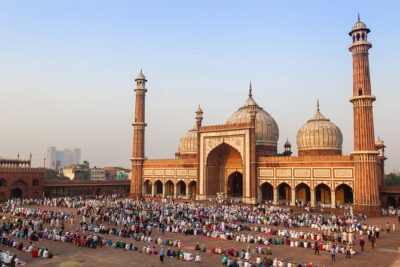
Jama Masjid and the courtyard scale you can feel
Old Delhi’s religious centerpiece here is Jama Masjid. The schedule lists about 20 minutes, but there’s a key difference: admission ticket not included.
The tour description says Jama Masjid was founded as Shahjahanabad by Shah Jahan and still maintains its Mughal character in some forms. It also includes a striking detail: the courtyard can accommodate 25,000 people.
That courtyard scale is the reason this stop works even in a short time. You can feel why large gatherings happened here. The guide can point out the layout and what it suggests about how the space was used.
Important budget note: since the entrance ticket is not included, you should expect you may have to cover entry separately if you want full access inside the complex.
Chandni Chowk via Pasar Chandni Chowk: where the day gets edible
Your next stop is Pasar Chandni Chowk, listed as the oldest market of Delhi with numerous food shops. Time on this stop is about 1 hour, and admission is listed as free.
This is where the tour shifts from monuments to everyday city life. You’re not just walking past shops—you’re getting a guided taste of how Old Delhi functions. Even if you don’t buy much, the point is to see the market rhythm and understand why it’s a magnet for food and local culture.
Practical tip: this is a good place to slow down your pace. Take in smells and signage, and decide on snacks only if you’re comfortable with street food. The tour includes lunch, but food and drinks aren’t automatically included here unless the tour specifies something on the day.
Raj Ghat: a short, meaningful break after the market noise
The day ends (or near-ends) at Raj Ghat, described as the cremation ground of Mahatma Gandhi, listed as the national father. Time here is about 20 minutes, and admission is included. The tour outline says you can visit or drive pass, so you might not spend the full time on foot depending on the day’s pacing.
This stop works because it’s not another building. It’s a pause. A short visit gives your brain a reset after forts, courtyards, and crowds.
If you’re someone who likes meaning in your travel: don’t rush this. Even 20 minutes can be enough to read the setting and feel the quiet.
Lunch and entrances included: why $25 can feel like a deal
The price is listed at $25, and the tour runs about 8 hours. At first glance, that sounds almost too low—until you look at what’s included.
Included items cover:
- Round-trip transport from your hotel
- Lunch
- English-speaking tour guide
- Monument entrances for Delhi stops (with the one listed exception at Jama Masjid)
- Rickshaw ride at Old Delhi
- Taxes and fees such as GST, plus parking and other charges
There’s also group discounts and a mobile ticket, both of which help reduce friction.
What’s not included is also clearly stated: food and drinks unless specified. So if you want bottled water, soft drinks, or snacks beyond lunch, you’ll likely pay separately.
My value take: this is best for you if you’d otherwise spend money and time piecing together transport and tickets. If you already have everything organized and just want a guide for a couple of monuments, the fixed loop may feel less efficient.
Rickshaw ride in Old Delhi: small time investment, big day payoff
The tour includes a rickshaw ride at Old Delhi. Even though the provided details don’t specify route length or exact timing, including it is a smart move: Old Delhi is the kind of area where walking can be the slow route and cars can be impractical.
A rickshaw gives you motion without the stress of navigating traffic yourself. It also adds a cultural layer that’s hard to replicate by car: you’ll feel the tight streets and the pace of the bazaar zones more directly.
Simple advice: wear comfortable shoes, keep your bag close, and be ready for quick stops and starts.
Who should book this Delhi loop, and who should skip it
This tour fits you best if:
- you’re seeing Delhi for the first time and want Old + New Delhi in one day
- you want a small group with guide commentary instead of self-guided chaos
- you care about value and prefer that lunch, tickets, and transport are handled together
You might want to skip or reconsider if:
- you’re visiting on a Monday and you specifically want both Lotus Temple and Red Fort, since the schedule flags Monday by-pass for both
- you dislike a structured day with multiple quick stops
- you don’t want to handle the extra cost that may come with Jama Masjid entrance (since it’s not included)
Should you book Delhi Day Tours with Lunch, Monument Entrance and Rickshaw Ride?
I’d book it if your goal is a well-managed “greatest hits with substance” day that still gives you Old Delhi texture. The standout strengths are the hotel pickup, the small group size, and the way the tour wraps lunch and many entrance fees into a single price so you don’t lose time on logistics.
Before you hit confirm, do two quick checks:
- Plan around the Monday by-pass notes for Lotus Temple and Red Fort
- Remember Jama Masjid entrance is not included, so budget for it if you want to go in
If you’re flexible on Monday and you’re okay with a full, guided day tempo, this is a strong value way to see Delhi without turning your vacation into a transportation project.
FAQ
How long is the tour, and what time does it start?
The tour starts at 9:00 am and runs for about 8 hours.
Does the price include lunch?
Yes. Lunch is included.
Is pickup and transportation provided?
Yes. The tour includes round-trip transportation from your hotel.
What entrance fees are included?
Entrance fees are included for several major sites such as Qutub Minar, Humayun’s Tomb, the Red Fort, and India Gate. Jama Masjid admission is not included.
Is there a rickshaw ride?
Yes. The tour includes a rickshaw ride at Old Delhi.
How big is the group?
The tour is described as a small group of 15 people or fewer. It is also listed as private for your group.
Can I cancel for a full refund?
Yes, the policy says you can cancel for a full refund if you cancel at least 24 hours before the experience start time. It also notes that if canceled due to poor weather, you’ll be offered a different date or a full refund.