REVIEW · NEW DELHI
Delhi Highlights: Old & New Delhi Tour with Guide and Transfers
Book on Viator →Operated by Crystal India Holidays · Bookable on Viator
Delhi hits hard, in the best way. I like the air-conditioned private car that keeps the day under control, and I love the included Old Delhi rickshaw ride that drops you into the bazaar energy fast. The only catch is that this is a long, packed 8 to 9 hour day, so you will feel the pace by late afternoon.
You get hotel or airport pickup, plus bottled water during the drive, which matters in Delhi traffic and heat. When you choose a guide option, the stops connect into a coherent story instead of feeling like a checklist.
Old Delhi landmarks like Jama Masjid and Chandni Chowk show the Mughal-to-modern contrast, while New Delhi adds big government architecture and major religious sites. If you’re visiting on a Monday, plan ahead because key sights like the Red Fort, Lotus Temple, and Swaminarayan Akshardham are closed that day.
In This Review
- Key things to know before you go
- A day that covers Old Delhi and New Delhi without the daily hassle
- Price and value: what $7.25 per person really means
- Starting in the right place: pickup, car size, and the AC factor
- Old Delhi on foot and by rickshaw: Jama Masjid and Chandni Chowk
- The included rickshaw ride through spice markets (and how to use it)
- Khari Baoli and Agrasen ki Baoli: spices plus a quieter contrast
- Red Fort area, Bangla Sahib, and India Gate: switching from empires to everyday faith
- Qutub Minar: the one stop you should not rush
- Lotus Temple and Swaminarayan Akshardham: faith you can see from a distance
- Humayun’s Tomb: gardens, symmetry, and why it’s worth the hour
- Raj Ghat and the afternoon mood: memorial without the heavy slog
- Monday closures: how to plan your day around them
- Should you book this Old & New Delhi highlights tour?
- FAQ
- What’s the main benefit of this tour compared to using public transport?
- How long is the tour?
- Where can the tour pick me up?
- Is there a guide on the tour?
- Are monument entrance fees included?
- Is lunch included?
- What’s included for Old Delhi specifically?
- What’s closed on Mondays?
- Can I cancel for a full refund?
- Is this tour private or shared?
Key things to know before you go

- Private, air-conditioned transport sized to your group (sedan, SUV, or van)
- Old Delhi rickshaw ride included, plus a market loop
- Entrance fees and lunch depend on your option, but many monuments are covered when included
- A guide can make or break the day, with guides like Dilip and Shiv Raj praised for clear explanations
- Street-smart guidance is part of the experience, including tips around keeping your belongings safe
- Monday closures can affect the Red Fort, Lotus Temple, and Swaminarayan Akshardham
A day that covers Old Delhi and New Delhi without the daily hassle

Delhi can be exhausting fast if you’re bouncing between neighborhoods on public transport. This tour is built to remove that pain. You’re in a comfortable AC car for the big transfers, and you spend your energy where it counts: at the sites.
The route also has a smart rhythm. You start with New Delhi pickup and head toward Old Delhi, where the pace slows in a different way—crowds, alleyways, and sensory overload. Then you move into New Delhi’s wider avenues and monumental spaces. The contrast is the point, and it’s hard to recreate on your own in just one day.
I also like that the tour is private. You’re not waiting around for stragglers or trying to bargain with a driver every time the plan changes. It’s just you and your group, with a guide when you select that option.
You can also read our reviews of more guided tours in New Delhi



Price and value: what $7.25 per person really means
At $7.25 per person, the headline price feels almost too good. The honest way to read it is to look at what’s included versus what’s optional.
Included basics: hotel/airport pickup and drop-off, private transport in an AC vehicle, bottled water, taxes/fees, and the Old Delhi rickshaw ride. If you choose the option that includes monuments, you also get entrance tickets, and lunch can be included depending on your selection.
There’s also a detail you should treat seriously: monument entrance fees can vary by visitor category (foreigners, SAARC/BIMSTEC countries, and Indian/OCI cardholders), and valid ID is required to receive the correct ticket type. So even when entrance fees are listed as included, the exact amount can depend on who you are.
In plain terms: for this price, you’re paying for convenience plus guide-guided logistics. If you’re traveling with more than one person, the value tends to get even better because the car and professional guidance don’t get diluted by a huge group schedule.
Starting in the right place: pickup, car size, and the AC factor

Pickup is wide open: you can meet the car at your hotel, airport, railway station, or other chosen pickup location in Delhi, Noida, or Gurugram. That’s a big deal if your first day is already busy or you land at a time when local transport is a headache.
Car type is handled by group size:
- 1 to 2 people: air-conditioned four-seater sedan
- 3 to 4 people: air-conditioned six-seater SUV
- 5 to 10 people: air-conditioned ten-seater van
This matters because Delhi roads can be chaotic, and a comfortable vehicle is not a luxury here—it’s fatigue control. One review also specifically noted a clean car and bottled water, which lines up with the included water you get during the journey.
Old Delhi on foot and by rickshaw: Jama Masjid and Chandni Chowk
The Old Delhi section is where the tour earns its name. You start with Jama Masjid, the Friday Mosque made of red sandstone. It’s built to hold around 25,000 people at once, so even if you arrive and the area is calmer, you still get a sense of scale. The guide explanations are especially helpful here, because the architecture and history can feel confusing if you’re just looking at stone and not knowing what to notice.
Next up is Chandni Chowk, the main drag in the older core of Shahjahanabad. This is the street where Delhi feels like it’s been running for centuries. You’ll see a dense mix of shops and food stops, and the whole area is designed for wandering—slowly.
Two practical notes for this part:
- Expect crowding, so keep your phone and wallet secure and easy to manage.
- If you want photos, ask your guide when to step aside and where it’s safer to pause.
The included rickshaw ride through spice markets (and how to use it)
The tour doesn’t just point you at markets; it includes a rickshaw ride for a loop around the Spice Market and Chandni Chowk market area. That’s a smart move because it gives you movement without requiring constant walking through the tightest sections.
A rickshaw ride also helps you read Old Delhi. From the seat, you notice how the streets braid together—where the food stalls cluster, where shop fronts thin out, and where crowds compress. You’ll get that sense fast, without turning it into a full-day detour.
When guides are at their best, they also give street-smart context. One review highlighted guide advice about protecting your belongings and watching for pickpockets. That kind of practical warning is worth more than a long lecture because you’re using it immediately.






Khari Baoli and Agrasen ki Baoli: spices plus a quieter contrast
After the big Old Delhi streets, Khari Baoli shifts the focus to spices. This market is described as Asia’s largest spice market in Old Delhi, with hundreds of shops selling local and exotic spices from around the country. Even if you don’t buy anything, it’s a sensory lesson: you can see the colors, smell the blends, and understand why spice trading became so important in this part of the city.
Then you get Agrasen ki Baoli, a step-well monument dating back to the 14th century. You’ll notice the geometry right away: about 103 steps down, descending into the space below. It’s a shorter stop than the big landmarks, but it works as a mental breather. Old Delhi tends to be loud; this spot offers a different kind of stillness.
If you’re the type who likes variety in a single day, this pairing is a good one: spice market energy, followed by a quiet stone moment.
Red Fort area, Bangla Sahib, and India Gate: switching from empires to everyday faith
Some itineraries make you choose between fortress history and modern Delhi life. This one tries to give you both.
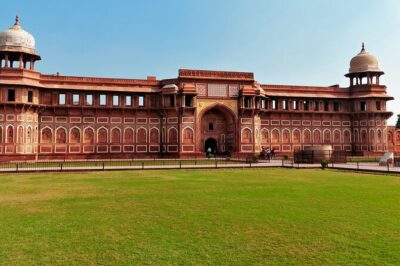
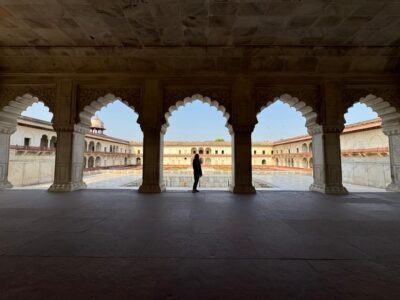
You’ll visit the Red Fort, a massive sandstone complex associated with Mughal rule for nearly two centuries. It took almost ten years to build, and it’s listed as a UNESCO World Heritage site. The scale is what hits first: this is not a small fort you can breeze past. It’s a statement in stone.
Then the tour moves to Gurudwara Bangla Sahib, famous for its white marble and onion-shaped domes. It’s a Sikh shrine with strong religious importance, and the area draws devotees. This stop is valuable because it’s not just about monuments—it’s about how people use sacred space every day.
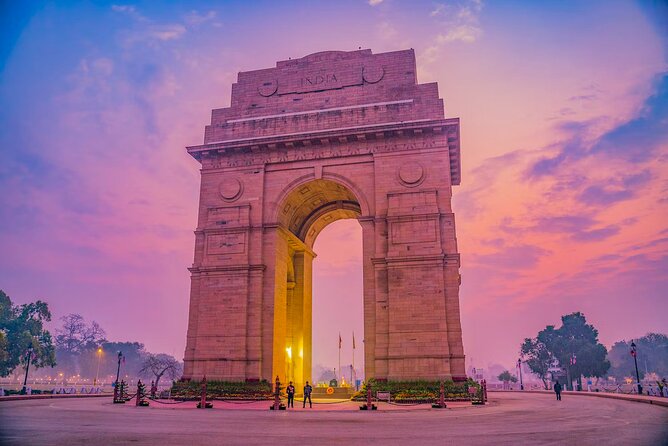
From there, you’ll head to India Gate, the 42-meter-high memorial arch designed by Lutyens. It’s dedicated to around 90,000 Indian Army soldiers. It’s quick, but the setting helps: even a short stop gives you a sense of national scale.
The itinerary also includes stops tied to the grand architecture of New Delhi:
- Parliament House (Sansad Bhavan), the place associated with Britain handing over power in 1947
- Rashtrapati Bhavan (President’s House), including its large corridors and Durbar Hall
These are the kinds of places where a guide helps you interpret what you’re seeing, because the buildings only make full sense when you know what they represent.
Qutub Minar: the one stop you should not rush

Qutub Minar is a major anchor for early Delhi. Expect a towering minaret described as about 73 meters high, with five storeys. The structure is tied to Qutb-ud-din and the defeat of Qila Rai Pithora, which gives it the kind of political backstory that makes the stone feel less abstract.
The longer you stand near Qutub Minar, the more detail you notice. And if your day is already packed, this is where you should spend a careful chunk of time. One review noted a guide meeting the traveler at Qutub Minar, and the overall praise for that kind of guided, on-site explanation lines up with how important this stop is.
Lotus Temple and Swaminarayan Akshardham: faith you can see from a distance
Delhi has several religious landmarks, but the styles here are distinct.
The Lotus Temple—also known as the Bahai House of Worship—stands out for its lotus-flower form. It’s described as tranquil and designed to bring various faiths together. Even if you’re not religious, architecture like this changes your pace. People slow down here for a reason: the space asks you to.
Then there’s Swaminarayan Akshardham, described as a spiritual-cultural campus with traditional and modern Hindu culture and architecture. It’s a large stop, and you may have options to visit parts of the complex depending on what’s available on the day.
One major consideration: Lotus Temple and Swaminarayan Akshardham close on Mondays. If you’re planning your trip around weekdays, this is worth building your itinerary around. On other days, these stops give your tour a more reflective finish compared with the busy Old Delhi stretches.
Humayun’s Tomb: gardens, symmetry, and why it’s worth the hour
If you want one place where the tour gives you breathing room without losing meaning, choose Humayun’s Tomb.
This monument is known for its symmetrical gardens and arched facades, blending Persian and Mughal elements. The description also calls it sublime and surreal, which is basically what you feel when you walk through a Mughal-era layout that’s designed for long viewing.
Humayun’s Tomb also works as a transition. After the strong identity landmarks of Old Delhi and after the faith architecture of the later stops, the tomb’s garden geometry resets your sense of time. It feels like a different kind of Delhi.
Raj Ghat and the afternoon mood: memorial without the heavy slog
Raj Ghat is a black marble platform marking the site of Mahatma Gandhi’s cremation on 31 January 1948. The memorial is straightforward, but it lands in a different way than the larger monuments.
You’ll likely feel a shift in the afternoon mood here. It’s not a stop that needs a lot of walking, which makes it useful on a day that’s already long. It also fits the tour’s mix: places of empire, places of faith, and places tied to modern India’s moral and political story.
Monday closures: how to plan your day around them
This is the one scheduling issue you should treat like a rule, not a suggestion. Red Fort, Lotus Temple, and Swaminarayan Akshardham are closed on Mondays.
If you’re traveling on Monday, you have a few smart options:
- Ask your guide to adjust the plan around the closed sites so your Old Delhi and New Delhi coverage stays balanced.
- If your priority is architecture over landmarks, you can still build a great day around the other included stops like Jama Masjid, Chandni Chowk, Khari Baoli, Qutub Minar, and Humayun’s Tomb.
If you’re flexible, you’ll be fine. If you’re not, check the day-of-week before you lock your schedule.
Should you book this Old & New Delhi highlights tour?
Book this tour if you want a high-effort day with low travel stress. It’s ideal for first-time Delhi visits, people who don’t want to deal with crowded public transport, and anyone who wants both the Old Delhi bazaar feel and the New Delhi monumental layout in one go.
Also consider it if you like guidance. Reviews highlight how much difference a good guide makes, including guides like Dilip and Shiv Raj for strong site explanations. Drivers like Anil are also praised for getting people safely to as many sights as possible, with a clean AC car and bottled water.
Skip or rethink if you have limited stamina for a long day. At roughly 8 to 9 hours, this is not a slow sightseeing stroll. And if you’re traveling Monday, make sure the closure list won’t sabotage your top 2 or 3 priorities.
FAQ
What’s the main benefit of this tour compared to using public transport?
You avoid riding Delhi’s crowded public transport. You get private transfers in an air-conditioned car and a guided route that connects major Old and New Delhi stops.
How long is the tour?
The duration is about 8 to 9 hours.
Where can the tour pick me up?
Pickup is available from your hotel, airport, railway station, or other desired locations in Delhi, Noida, or Gurugram.
Is there a guide on the tour?
The tour includes a private local professional guide if you choose the option that includes the guide. One review specifically mentioned guides such as Dilip and Shiv Raj.
Are monument entrance fees included?
Entrance fees are included if you choose an option that covers them. The tour also notes that entrance ticket prices can differ based on visitor category, and valid ID is required.
Is lunch included?
Lunch is included if you select the option that includes lunch.
What’s included for Old Delhi specifically?
You get entry fees (if your option includes them) and an included rickshaw ride in Old Delhi, along with stops like Jama Masjid and Chandni Chowk.
What’s closed on Mondays?
The Red Fort, Lotus Temple, and Swaminarayan Akshardham remain closed on Mondays.
Can I cancel for a full refund?
Yes. You can cancel up to 24 hours in advance for a full refund.
Is this tour private or shared?
It’s a private tour/activity. Only your group will participate.