REVIEW · NEW DELHI
5-Day Private Luxury Golden Triangle Tour From Delhi
Book on Viator →Operated by Best Golden Triangle Tour · Bookable on Viator
Five icons in five days. That’s the deal with this private Golden Triangle run through Delhi, Agra, and Jaipur. I like the private guided tours that keep big sites from feeling like a shopping-list, and I also like the hotel pickup and drop-off that saves you from day-one chaos. The main drawback is simple: monument entrance fees aren’t included, so you’ll want to budget for tickets at places like the Taj Mahal, Humayun’s Tomb, and Qutub Minar.
This package is built for comfort without pretending travel in India is effortless. You get water while traveling, all tolls and parking are covered, and you’re on a private schedule with only your group. You’ll also have to accept a tight pace: each stop gets a set window (often 30–60 minutes), so you’ll be moving and deciding fast.
One more plus: it’s priced as a private luxury option with lots of core services included, and it’s shown with a strong track record (100% recommended, 5/5 rating based on 45 ratings). Still, that value only holds if you’re okay paying entrance fees separately and keeping your expectations aligned with a well-packed 5-day loop.
In This Review
- Key things to know before you go
- Why the Golden Triangle works in 5 days
- Delhi in one day: Humayun’s Tomb, Qutub Minar, Lotus Temple, Old Delhi, and memorial time
- Agra’s essentials: Taj Mahal, Agra Fort, Itmad-ud-Daula, and Mehtab Bagh
- Fatehpur Sikri: Akbar’s UNESCO city with a free-ticket advantage
- Jaipur’s big architecture day: City Palace, Hawa Mahal, Jantar Mantar, and temple stops
- Comfort, transport, and the guide factor you can actually feel
- Price and value: what’s included versus what you’ll pay at the gates
- Who should book this Golden Triangle tour
- Should you book this 5-day private luxury Golden Triangle tour?
- FAQ
- How long is the Golden Triangle tour?
- Which cities are included?
- Is hotel pickup and drop-off included?
- Is an English-speaking guide provided?
- Are monument entrance fees included?
- What about meals—are breakfasts included?
- Do I get mobile tickets?
- What is the cancellation window?
Key things to know before you go
- Private English-speaking guide: You get one guide for your group, not a crowded bus explanation.
- Entrance fees are extra: Several of the biggest sights list tickets as not included, so plan cash/card for gates.
- A real comfort package: Water during travel, tolls and parking covered, and hotel time built in (4 nights).
- A classic UNESCO hit list: Humayun’s Tomb, Qutub Minar, the Taj Mahal, Agra Fort, and Fatehpur Sikri make the route.
- Jaipur beyond the postcard shots: City Palace, Hawa Mahal, Jantar Mantar, plus multiple temples and Galtaji (Monkey Temple).
- Time-boxed visits: You’ll see a lot, but you won’t linger all day at one place.
Why the Golden Triangle works in 5 days
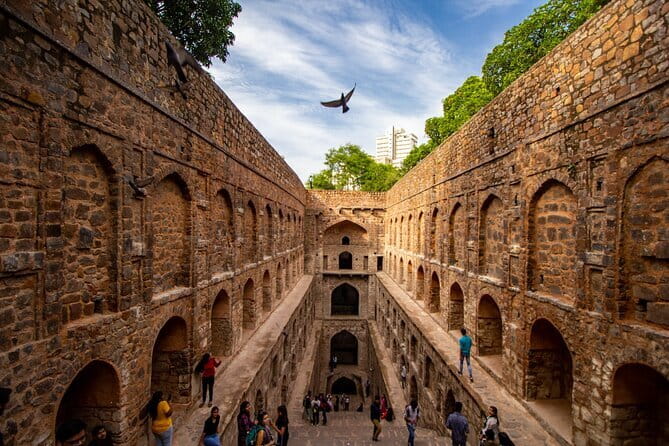
The Golden Triangle is popular for a reason: it links three cities that each feel like a different chapter. Delhi mixes Mughal monuments with major memorials. Agra brings you straight to the Taj Mahal and the Mughal court vibe. Jaipur gives you architecture, astronomy, and a lot of temple time.
What makes this version practical is the structure. You’re not doing a confusing DIY shuffle between cities. You’re in private transport with a guide, plus a built-in hotel plan for 4 nights. And because the tour is described as luxury five-star accommodations, your downtime after packed sightseeing should feel like a real reset.
That said, five days is tight for three cities. You’ll enjoy the drive days more if you’re ready to trade long, slow meals for early starts and efficient transitions.
You can also read our reviews of more private tours in New Delhi

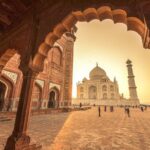

Delhi in one day: Humayun’s Tomb, Qutub Minar, Lotus Temple, Old Delhi, and memorial time
Day 1 is a smart mix of “big monument” energy and calm spiritual stops. You start with two UNESCO-class Mughal masterpieces.
Humayun’s Tomb is first, and it’s a great opener. Expect a garden-and-mausoleum layout that shows how Mughal builders used symmetry and landscape as part of the architecture. You’ll have about an hour, and entrance is listed as not included—so plan for ticket time and security.
Next is Qutub Minar, the tall stone minaret that reaches about 72.5 meters. You’ll get roughly an hour here too. It’s famous for its carvings and Quranic inscriptions, and it’s also a handy spot for learning how early Delhi Islamic architecture evolved over time. Entrance is again not included, so budget accordingly.
Then the tour shifts gears with two very different “peace and power” stops.
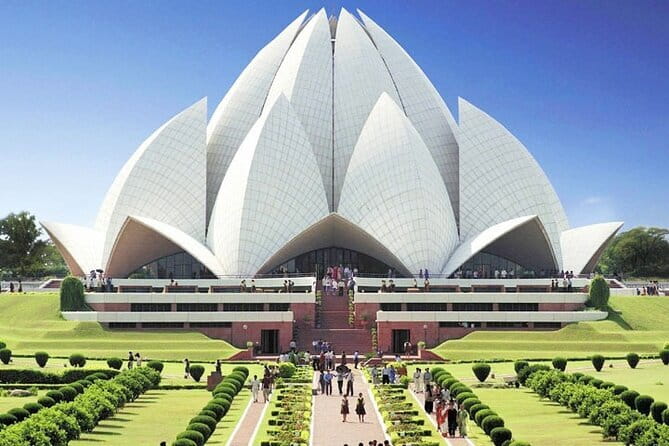
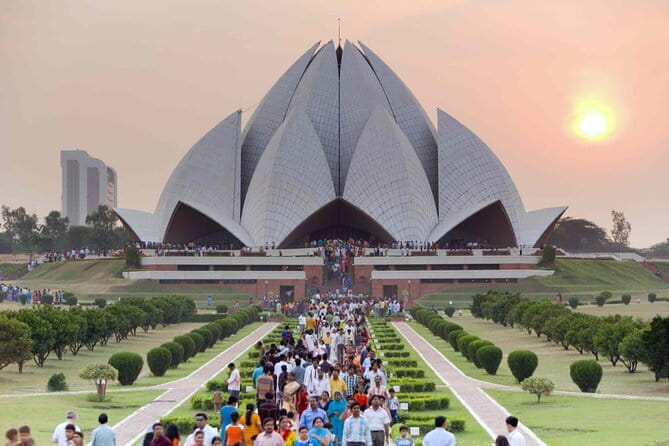
Lotus Temple is about 30 minutes and is listed as free. The lotus shape is the headline, but what I like is that it’s open to people of all faiths and it functions as a House of Worship. It’s a nice breathing space between ticketed monuments.
Jama Masjid is your Old Delhi moment, about 30 minutes with free entry listed. It’s one of the largest mosques in India and was built by Shah Jahan in the 1600s. If you’ve got any interest in how cities organize around religious centers, this stop gives you that perspective fast.
The day ends with two quick, meaningful memorial stops that keep you grounded.
India Gate (15 minutes, free) is a war memorial designed by Sir Edwin Lutyens, ringed by lawns and open space. Raj Ghat (15 minutes, free) is the simple black-marble platform marking Mahatma Gandhi’s cremation site. You’re not stuck here for an hour; you’re getting a clean, respectful snapshot.
Practical tip: since several Delhi sites are free but the two big ones (Humayun’s Tomb, Qutub Minar) aren’t, it’s worth carrying a bit of extra cash/card on Day 1 for those tickets.
Agra’s essentials: Taj Mahal, Agra Fort, Itmad-ud-Daula, and Mehtab Bagh
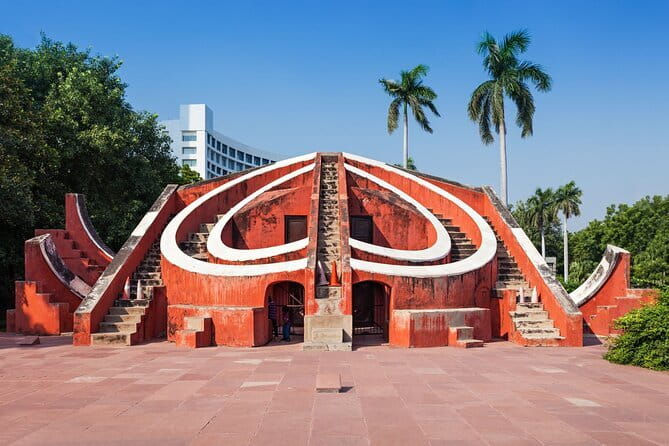
Agra is where the route earns its name. The pacing is classic Golden Triangle: one headline monument, plus the Mughal neighborhood around it.
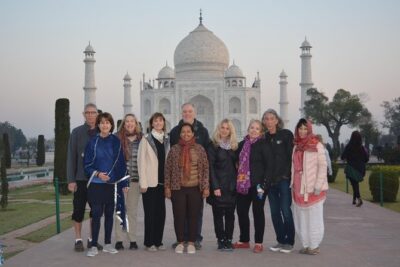
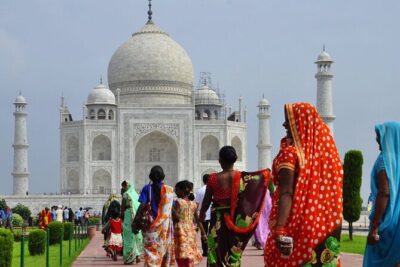
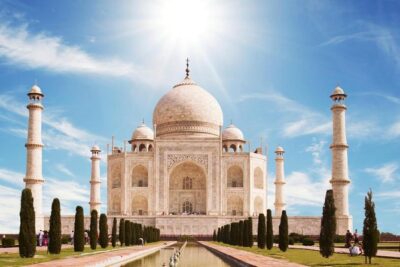
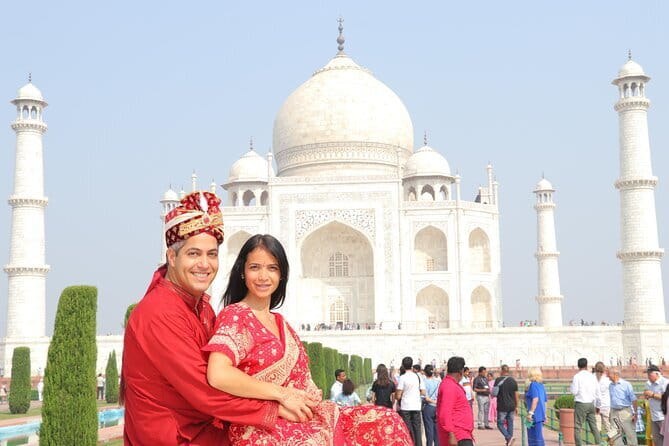
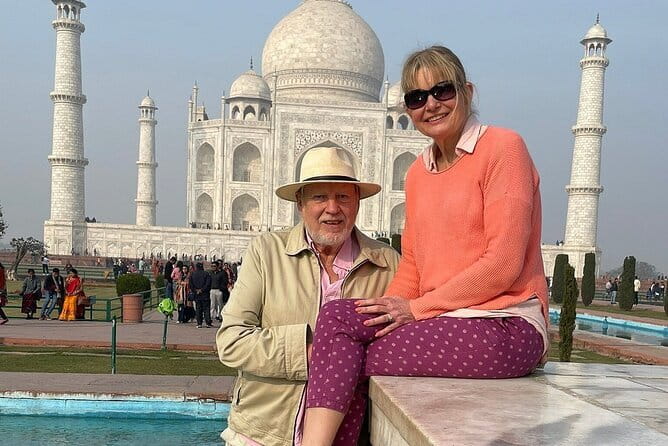
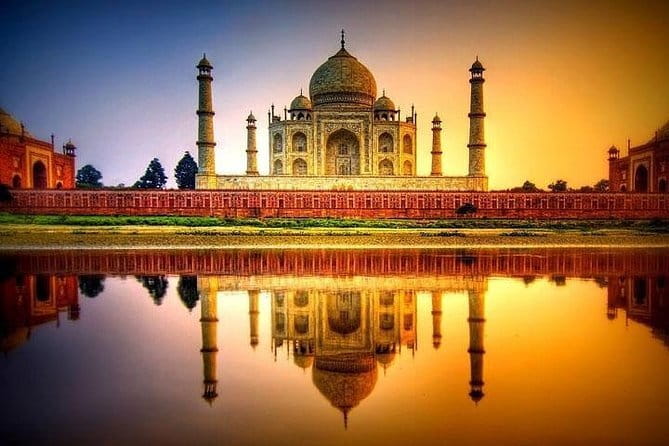
You’ll spend about 45 minutes at the Taj Mahal. It’s listed as admission not included, so you’ll pay separately. The white marble and the symmetry do most of the talking here. I find the best value is using the time you’re given to look at details: how light changes the surface, how the garden frames the main structure, and how the monument reads from different angles.
Next is Agra Fort (about 1 hour, tickets not included). This is the Mughal stronghold side of the story. You’ll see how the power structures worked in everyday terms—courtyards, palatial spaces, and fortress design all in one complex. If the Taj is the love story, Agra Fort is the power story.
Then you get Itmad-ud-Daula—often called the Baby Taj. You’ll have about 30 minutes, and entrance is not included. What makes it compelling is the scale shift. It’s smaller than the Taj but still packed with delicate marble inlay work, and that makes it feel like a “slow down and notice” stop.
Last is Mehtab Bagh, the garden area across the Yamuna. You get about 30 minutes, with tickets not included. Even if you don’t think of yourself as a “views” person, this stop helps you understand the Taj’s setting—the way the river, gardens, and symmetry were planned as part of the design.
Tradeoff to expect: Agra can feel intense because the highlights are all close together but not identical in mood. If you like variety, you’ll be happy. If you’re the type who loves one site for hours, you might wish you had more time than the fixed windows allow.
Fatehpur Sikri: Akbar’s UNESCO city with a free-ticket advantage
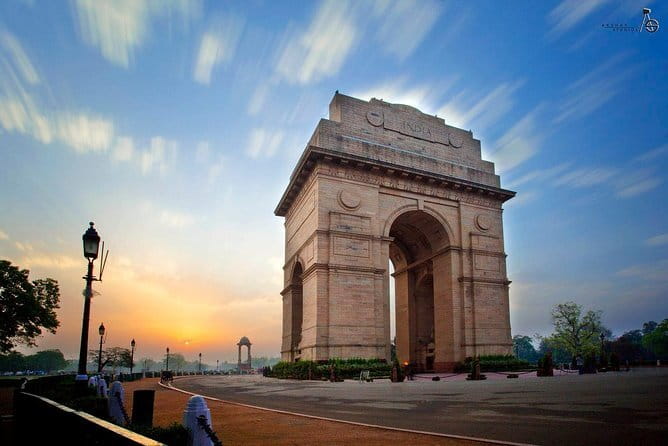
Day 3 is Fatehpur Sikri, about an hour on the clock, and this one is listed as free entry. That alone is a value win: you’re adding a major UNESCO stop without paying another gate fee.
Fatehpur Sikri is a historic city built by Emperor Akbar in the 16th century, and it’s known for Indo-Islamic architectural blends. In this route, it acts like a “context reset.” You’re not just chasing famous monuments; you’re stepping into the broader story of how emperors planned and built entire city spaces.
Because your time is about an hour, go in with one goal: look at the complex layout and learn the big picture. If you try to read every detail, you’ll lose the feeling of the place. The value here is seeing how a whole city idea was executed in stone.
Jaipur’s big architecture day: City Palace, Hawa Mahal, Jantar Mantar, and temple stops
Jaipur is the most varied day on paper. It starts with royal space, then shifts to architectural spectacle, then to astronomy, then to temples.
City Palace is about 1 hour, and entrance is not included. It’s a royal complex where Mughal and Rajasthani styles overlap. Even if you’re not an “indoor museum” person, this is worth it for the sense of how the city’s power lived inside palatial courtyards.
Next is Hawa Mahal, the Palace of Winds. You’ll get about 30 minutes, with tickets not included. The famous face is pink sandstone, and the building is covered with 953 jharokhas (window-like openings). What I like is how it explains the architecture: it’s designed for visibility and ventilation at once, tied to life in the old city.
Then comes Jantar Mantar, about 30 minutes and UNESCO-listed. Tickets are not included. This is the astronomy stop, with large instruments built in the 18th century under Maharaja Sawai Jai Singh II. If you’re a science-minded traveler, you’ll love seeing how measurement tools became public architecture.
After the structured “royal and scientific” blocks, the day turns more spiritual.
Birla Mandir Temple (about 30 minutes) is a marble temple dedicated to Lord Vishnu and Goddess Lakshmi. Entrance is not included. It’s a calm change of pace, and it’s a good place to reset your brain after Hawa Mahal’s busy exterior.
Govind Dev Ji Temple (about 30 minutes) is inside the City Palace complex and is dedicated to Lord Krishna, with idols brought from Vrindavan. Tickets are not included. This stop adds a devotional layer that feels different from the architecture-heavy sites.
Finally, you have Monkey Temple, also called Galtaji Temple, about 30 minutes. It’s in the Aravalli Hills and is known for sacred water tanks (kunds) and natural springs. Tickets are not included.
Pace note: Jaipur can feel like a “show schedule” because you’re hitting major landmarks back-to-back. The upside is you’ll cover a lot of Jaipur without needing a car and a plan. The downside is you may not get that one slow, favorite stop. If you want to linger, you’ll likely do it at the temple moments rather than the ticketed landmark windows.
You can also read our reviews of more tours and experiences in New Delhi






Comfort, transport, and the guide factor you can actually feel
In India, the difference between a tiring trip and a manageable trip is often the basics. This package includes hotel pickup and drop-off, private transportation, and a dedicated English-speaking private guide. Those sound like bullet points, but you’ll feel them when you don’t have to negotiate routes, tickets, or meeting points.
You’ll also get water while traveling, plus toll taxes and parking handled. That matters more than people think, especially across city-to-city travel days. Every time you don’t need to stop for logistics, you gain time for the sites themselves.
The hotel side is described as five-star accommodations for 4 nights (single or double sharing). That’s a big value piece if you’re doing the Golden Triangle loop because you’ll likely be walking and riding a lot. A good bed after a sightseeing day is not a luxury; it’s part of the itinerary working.
Guide names: one shared example in the provided information is Mr. Mohd. Riyaz, mentioned as a guide for Delhi and Agra. If you’re assigned someone with that kind of local skill, the monuments feel less like photos and more like living places.
Price and value: what’s included versus what you’ll pay at the gates
The price shown is $31.50 per person for this 5-day private luxury Golden Triangle tour. On paper, that’s attractive because several essentials are already covered: pickup/drop-off, private guide, 4 nights lodging, and breakfast for 4 mornings, plus water during travel and tolls/parking.
But the value equation changes once you remember the big line item you’ll handle yourself: monument entrance fees aren’t included. From the stop details, tickets are not included at key sights like Taj Mahal, Humayun’s Tomb, Qutub Minar, Agra Fort, Itmad-ud-Daula, City Palace, Hawa Mahal, Jantar Mantar, and multiple temples. Some places are listed as free—like Lotus Temple, India Gate, Raj Ghat, Jama Masjid, and Fatehpur Sikri—so not every stop will cost you. Still, the major “name” sights will.
So how should you think about the price? If you want a private tour with real hotel time and an English guide, this is positioned as a cost-effective way to get there. If you only care about saving money on entrances and don’t mind DIY logistics, you might find other options. The key is being ready for extra entrance payments at the ticketed monuments.
Practical budget move: set aside a separate amount for gates on days 1, 2, and 4, because those are where the ticketed highlights are listed.
Who should book this Golden Triangle tour
This tour fits best if you want structure and comfort. I’d send it to:
- Families who want less stress and a guide to keep everyone on track.
- First-time visitors who don’t want to handle city-to-city logistics.
- Couples or friend groups who value a private schedule over group bus tours.
- Anyone who likes hitting iconic monuments but also wants some variety in Jaipur (architecture plus temples).
It might not be ideal if you’re the type who wants half a day in one place, slow streets, and spontaneous detours. This experience is built around set site windows—great for coverage, not built for lingering.
One more thought: because drinks aren’t included, you should plan for bottled water purchases beyond what’s provided, and you’ll pay for any meals outside breakfast. Keep that in mind when you compare total daily cost.
Should you book this 5-day private luxury Golden Triangle tour?
If your priority is seeing Delhi, Agra, and Jaipur with minimal hassle, this is a strong pick. You get a private English guide, pickup/drop-off, 4 nights of five-star-level comfort, and 4 breakfasts, plus water and basic travel costs handled. The route hits the major classics (Taj Mahal, Humayun’s Tomb, Qutub Minar, Jantar Mantar), and you also get a helpful day trip to Fatehpur Sikri with free entry listed.
My main caution is budget clarity. Entrance fees are not included, and several of the most famous stops are ticketed. If you’re okay with that and you like a packed, efficient schedule, this tour seems like a good value way to do the Golden Triangle.
If you want my quick call: book it when you want private structure and comfort, and you’re happy to pay monument gates separately.
FAQ
How long is the Golden Triangle tour?
It’s listed as 5 days (approximately) with 4 nights of accommodation.
Which cities are included?
The tour covers New Delhi, Agra, and Jaipur.
Is hotel pickup and drop-off included?
Yes. Hotel pickup and drop-off are included.
Is an English-speaking guide provided?
Yes. The tour includes an English-speaking private guide.
Are monument entrance fees included?
No. Monument entrance fees are not included. Some stops are listed as free, but tickets are not included for several major attractions.
What about meals—are breakfasts included?
Breakfast is included for 4 mornings (with the 4 nights of accommodation). Drinks are not included.
Do I get mobile tickets?
Yes. A mobile ticket is included.
What is the cancellation window?
Free cancellation is available up to 24 hours in advance for a full refund. Within 24 hours, the refund isn’t available.