REVIEW · NEW DELHI
Private Old and New Delhi Full-Day Tour with Akshardham Temple
Book on Viator →Operated by A Star Tours · Bookable on Viator
One Delhi day, two eras, zero ticket chaos. This private full-day route strings together Delhi’s most famous sights—Old Delhi history and New Delhi landmarks—while an English-speaking guide keeps the flow moving. You’ll also ride in an air-conditioned car, then switch modes for a cycle rickshaw through Chandni Chowk.
Two things I really like: the tour includes paid monument tickets for the big-ticket stops (so you’re not stuck at counters), and it’s built around a private guide who leads the way from hotel pickup to final drop-off. A small consideration: it’s a long day (around 7–8 hours) and lunch isn’t included, so you’ll want to plan how you’ll eat and recharge.
In This Review
- Key things that make this tour work
- Old Delhi meets New Delhi in one focused route
- Price and what makes it feel like value at $150
- How the pickup and AC car change the whole day
- Swaminarayan Akshardham: a massive 10,000-years story in about 90 minutes
- Chandni Chowk by cycle rickshaw: market life with real momentum
- Jama Masjid and the Red Fort area: Mughal scale, in two big doses
- India Gate pass-by: a quick, meaningful pause between eras
- Lotus Temple: the quiet contrast that keeps the day from feeling heavy
- Qutub Minar: UNESCO tower power, with admission included
- Timing and pacing: how to make a 7–8 hour day feel manageable
- Who this private Old and New Delhi tour is best for
- Should you book this tour?
- FAQ
- How long is the Old and New Delhi full-day tour?
- Is this tour private or shared?
- Does the tour include pickup from my hotel or the airport?
- What does skip the line mean on this tour?
- Are admission tickets included for all attractions?
- Is lunch included in the price?
- Is there free cancellation?
Key things that make this tour work
- Skip-the-line ticket handling: entrance tickets are paid for on key monuments so you spend less time queuing.
- Private, guide-led routing: you’re not trying to navigate Delhi’s traffic and street layers alone.
- Cycle rickshaw time in Chandni Chowk: you get a real street-level view of one of Delhi’s oldest markets.
- Air-conditioned transport all day: you’ll appreciate this between clustered stops and heat breaks.
- A strong lineup of contrasts: Akshardham, Jama Masjid/Red Fort area, Lotus Temple, and Qutub Minar in one day.
- Flexibility with your pace: the guide has been accommodating when plans need to change mid-day.
Old Delhi meets New Delhi in one focused route
This tour is designed like a smart day-plan, not a sightseeing checklist. You start with major monuments in the capital’s spiritual and historical neighborhoods, then you move into New Delhi for big, iconic, easy-to-find landmarks. The best part is how the itinerary balances spectacle with variety—so you’re not stuck doing only palaces, only temples, or only modern buildings.
Also, the private format matters more than it sounds. You can keep your eyes on the sights instead of constantly checking routes, arguing about which lane to stand in, or trying to coordinate multiple taxis. A live guide is there to keep you pointed in the right direction and explain what you’re seeing as you go.
You can also read our reviews of more private tours in New Delhi



Price and what makes it feel like value at $150
At $150 per person for about 7–8 hours, you’re paying for the whole package: hotel or airport pickup, private AC transport, a live English guide, and included tickets for the paid monuments on the schedule. The free-entry stops still matter, because the guide and transport are what prevent your day from turning into logistics.
Here’s the value logic that stands out:
- Included admissions for Akshardham and Qutub Minar take away one of the biggest time-and-stress drags.
- You get private transport plus a guide for the entire day, which is often where self-guided plans become expensive (and slower).
- Chandni Chowk includes a cycle rickshaw ride, which is usually one of the more memorable moments of Old Delhi-style sightseeing.
The main trade-off is simple: you’re not getting lunch. So the tour price feels fairer if you treat meals as an add-on you plan carefully rather than assuming it’s handled.
How the pickup and AC car change the whole day
Delhi’s distances and traffic can turn a good plan sour fast. With this tour, you start with pickup from your Delhi hotel or from the airport, then you’re in an air-conditioned car for the movement between clusters of sights.
That AC ride time isn’t just comfort. It’s practical. It gives you a breather between environments—especially helpful when you’re shifting from Old Delhi’s street energy to the calm of New Delhi monuments. You also avoid burning time trying to coordinate rides between neighborhoods.
The tour also includes a mobile ticket, which is one less thing to manage during a day when you’ll already have entrances, photo spots, and changing neighborhoods.
Swaminarayan Akshardham: a massive 10,000-years story in about 90 minutes
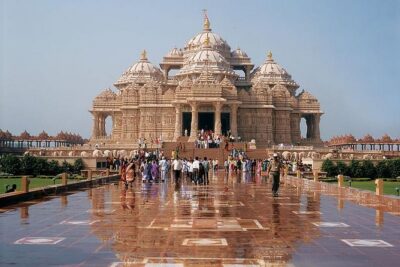
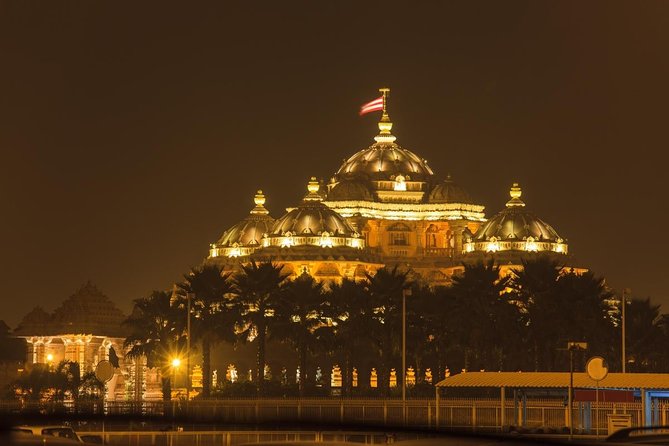
Akshardham is the “big first stop” for a reason. This is the kind of complex that feels like an entire world. The tour time you get is about 1 hour 30 minutes, with admission included, which is a realistic window for seeing the highlights without turning the day into an endurance test.
What makes it interesting is the way it frames Indian culture and heritage on a huge scale. The description focuses on the idea of 10,000 years of Indian culture and heritage, presented with breathtaking grandeur, beauty, and bliss. Even if you don’t go deep into every detail, you’ll still get that overall effect: the complex is meant to be seen, not just passed through.
A practical note for Akshardham: because it’s a large site, you’ll likely get more from moving with the guide and prioritizing what you want to see rather than trying to wander freely. With a guided schedule, you can catch the key sights in the time window.
Chandni Chowk by cycle rickshaw: market life with real momentum
After Akshardham, the tour pivots hard into Old Delhi street life. At Chandni Chowk (listed as about 1 hour), you’ll do a cycle rickshaw ride and explore the area.
Chandni Chowk is famous for being busy and old, with a focus on small ornaments and local culture. In a place like this, a car can feel like the wrong tool. The cycle rickshaw helps because it slows you down just enough to notice what makes the market different—shopfront textures, street-level bargaining energy, and the general rhythm of the lanes.
One key consideration: Old Delhi streets can be crowded. Your comfort will depend on how patient you are with narrow lanes and lots of people around you. The upside is that you’re not just looking at buildings; you’re seeing the city as it actually functions.
You can also read our reviews of more tours and experiences in New Delhi






Jama Masjid and the Red Fort area: Mughal scale, in two big doses
Jama Masjid comes next for about 1 hour, with admission listed as free. It’s described as the largest mosque in India, with a courtyard that can hold 25,000 devotees. It began in 1650 by Mughal Emperor Shah Jahan, and the construction effort reportedly involved more than 5,000 workers over six years.
That courtyard number changes how you think about the place. Jama Masjid isn’t just impressive because it’s old; it’s impressive because it was built to handle enormous gatherings. Even during a non-event visit, that scale is part of the experience.
Right after that, the Red Fort is included as a stop (with time not fully specified in the summary, but it’s on the route). It was constructed in 1648 by the fifth Mughal Emperor Shah Jahan and served as the residence of the Mughal emperor for about 200 years until 1857. From a sightseeing perspective, it also works as a visual anchor: massive red sandstone walls next to the broader historic area.
One thing to keep in mind: the tour includes Red Fort in the plan, but not every moment may be spent inside. If you’re hoping for a deep, hour-by-hour exploration of every interior, you’ll want to set expectations around the guided pacing.
India Gate pass-by: a quick, meaningful pause between eras
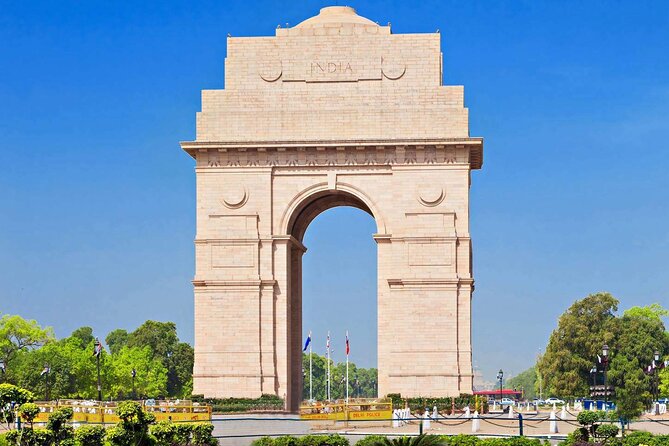
India Gate is part of the day as a pass-by. It’s described as a memorial to the 82,000 soldiers of the undivided Indian army who died between 1914 and 1921 during World War One.
Even as a pass-by stop, it’s worth paying attention for the context it brings. It’s one of those landmarks that can feel like background scenery if you don’t have the story attached. With a guide, you get the framing quickly, so the memorial doesn’t become just another photo backdrop.
Lotus Temple: the quiet contrast that keeps the day from feeling heavy
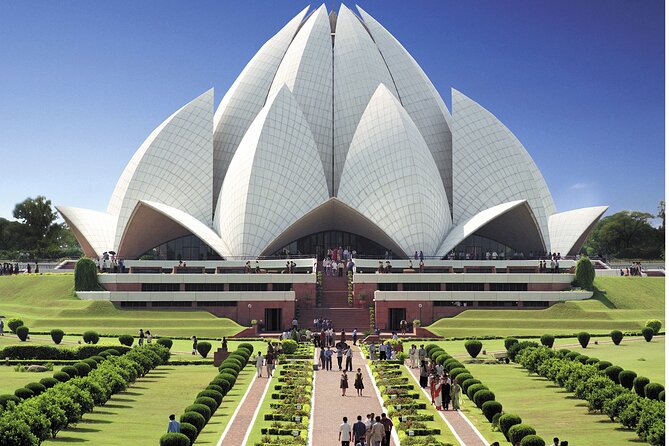
Lotus Temple is listed as a visit of about 1 hour, with admission free. It’s built in the shape of a lotus flower and described as the last of seven major Bahá’í temples built around the world, completed in 1986. The lotus shape is tied to the idea of a symbol common across all major Bahá’í temples.
This is one of the best “breather” stops in the itinerary. After mosque and fort imagery from earlier, Lotus Temple is a different kind of experience—more about form, calm, and symbolism than walking through the Mughal-era layout.
Because it’s free entry and the visit time is reasonable, it’s also a good point in the day to reset your pace. If you like a little quiet time with your photos and your thoughts, this is where the schedule gives you some breathing room.
Qutub Minar: UNESCO tower power, with admission included
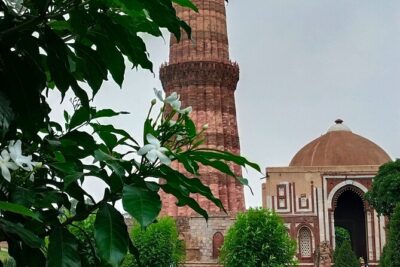
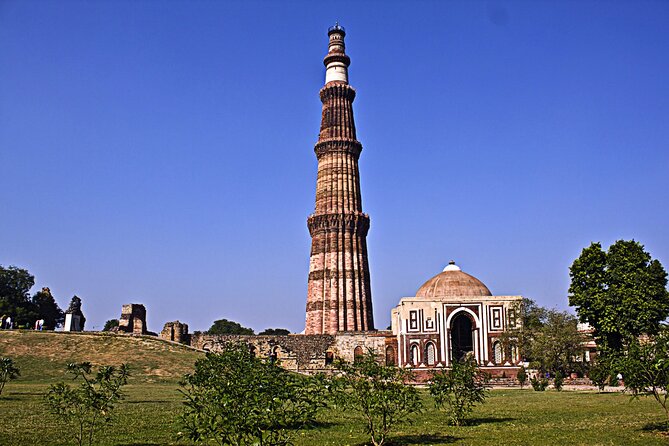
Qutub Minar rounds out the paid admission stop(s), with a visit listed around 1 hour and admission included. This is one of Delhi’s signature silhouettes: a 73 m-high tower and described as the tallest brick minaret in the world. It was built in 1193 by Qutub-ud-din Aibak and is declared as a UNESCO World Heritage site.
The reason this stop is such a strong finish is simple: it gives you a “vertical payoff.” After the flat-feeling street textures of Old Delhi and the architectural forms you saw earlier, Qutub Minar brings the eye upward and gives your brain a clear visual landmark to process.
Also, since the admission is included, you avoid paying separately and you likely avoid the extra time friction. In a full-day plan, saving minutes at entrances can mean gaining minutes for photos and explanations.
Timing and pacing: how to make a 7–8 hour day feel manageable
This is an active day built on a tight sequence of landmarks. About 7–8 hours means you’ll be in motion and switching environments frequently.
Here’s what helps you enjoy it more:
- Treat the day as one long sightseeing arc, not many separate mini-trips. That mindset keeps you from getting annoyed when one stop feels “short.”
- Since lunch isn’t included, plan to eat before or after the tour, and consider a light snack strategy during the day (the exact timing depends on how the guide spaces stops).
- Use the guide to prioritize. When you have only an hour at a complex, listening and following a simple plan beats aimless wandering.
The itinerary is built so you see a lot without getting trapped in any one location for too long. That’s a win if you want breadth in a limited time window.
Who this private Old and New Delhi tour is best for
I think this tour fits best when you want:
- A private guide-led day rather than a DIY route through traffic and crowds.
- A clean mix of Old Delhi and New Delhi landmarks.
- A day plan where key entrances are handled, including paid tickets for Akshardham and Qutub Minar.
- The experience of a cycle rickshaw ride in Chandni Chowk, without having to figure out how to arrange it.
It’s also a good fit if you appreciate a guide who keeps things practical. The experience has been described as thorough within a short period, and the guide has shown flexibility when the schedule needs to be cut short due to illness—meaning the tour doesn’t feel rigid if your day goes off plan.
Should you book this tour?
Yes—if you want an efficient, guide-led day that covers major hits across both Old and New Delhi, this is a solid choice. The strongest reasons to book are the private setup, the air-conditioned transport, the skip-the-line ticket handling for major admissions, and the high-contrast lineup: Akshardham, Chandni Chowk by rickshaw, Jama Masjid/Red Fort area, Lotus Temple, and Qutub Minar.
I’d only hesitate if you hate long days or you’re the type who needs long, slow hours inside every monument. With this schedule, you’ll get a lot of highlights, but it’s still a guided pace.
If your goal is to see the real Delhi variety in one day and avoid the annoying parts of figuring it out, this one earns its place.
FAQ
How long is the Old and New Delhi full-day tour?
The tour lasts about 7–8 hours, depending on the day’s flow and timing at the stops.
Is this tour private or shared?
It’s a private tour. No other guests join your group.
Does the tour include pickup from my hotel or the airport?
Yes. Pickup is offered from your Delhi hotel or from the airport.
What does skip the line mean on this tour?
It means all monument entrance tickets for the paid sights are handled, so you don’t have to buy them yourself at the site.
Are admission tickets included for all attractions?
Admission is included for Akshardham (listed at about 1 hour 30 minutes) and Qutub Minar (listed at about 1 hour). Other listed stops are marked as free, including Chandni Chowk, Jama Masjid, Lotus Temple, and India Gate is pass-by.
Is lunch included in the price?
No. Lunch or any other meal is not included.
Is there free cancellation?
Yes. You can cancel up to 24 hours in advance for a full refund.