REVIEW · NEW DELHI
Taj Mahal skip the line – Luxury Tour
Book on Viator →Operated by Akbran Tour · Bookable on Viator
Agra in one long, guided day. The appeal here is simple: you get a private round-trip plan from Delhi, guided stops at the Taj Mahal complex and two other Mughal icons, plus a sunset view from Mahtab Bagh across the Yamuna.
I also like that the guide experience can be very practical, with clear explanations that help you read the Taj and its symbolism, not just take photos. In one set of feedback, the guide Sumit got credit for keeping everything on track and attention high.
One thing to consider is cost on the ground: the big monuments do have entrance fees and the day includes a lunch break where food is for you to handle.
In This Review
- Key takeaways before you go
- A smooth, full-day way to hit Agra from Delhi
- The route that makes the Taj feel less rushed
- Taj Mahal time: what a good guide should help you notice
- Agra Fort: Mughal power in stone (and the Shah Jahan twist)
- Itmad-ud-Daulah (Baby Taj): smaller scale, lots of precision
- Mahtab Bagh at sunset: the Taj view most people skip
- Price and value: what $5 can realistically mean for you
- Tickets, lunch, and the money decisions that affect your day
- Who should book this Taj Mahal luxury-style private tour
- Quick practical advice for your day in Agra
- Should you book? My take
- FAQ
- FAQ
- How long is the Agra day trip from Delhi?
- Does the tour include hotel pickup and drop-off in Delhi?
- Is transportation private and air-conditioned?
- Is the tour only for my group?
- What are the main sightseeing stops during the day?
- Are entrance fees included?
- Is lunch included?
- What is the maximum group size per booking?
- Do I need passport details when booking?
- What is the cancellation policy?
Key takeaways before you go
- Private hotel pickup and drop-off in Delhi so you start with fewer headaches
- Time with a guide that helps you understand the Taj, Red Fort, and Itmad-ud-Daulah, not just walk through
- Mahtab Bagh sunset views across the Yamuna, a smart add-on that most fast trips skip
- Full-day schedule (about 14 hours), so plan comfortable shoes and a slower pace
- Max 16 people per booking, which usually feels manageable for a long day
A smooth, full-day way to hit Agra from Delhi
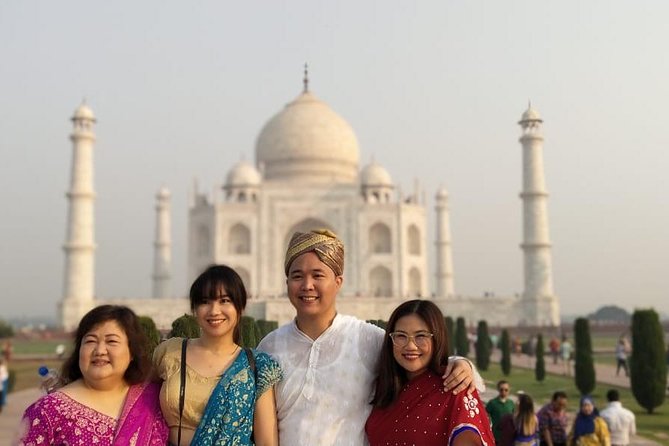
If you only have one day to work with, Agra can feel like a sprint. This kind of private day trip is designed to cut out the biggest time drains: figuring out transport, negotiating with drivers, and getting lost between monuments. You leave Delhi by private vehicle, you arrive with your guide ready, and you come back to your hotel when the day is done.
The tour is built around three priorities. First, the Taj Mahal itself, with guided context so you notice details that casual visits miss. Second, two more Mughal sites in Agra that most people either skip or see too quickly. Third, the sunset moment from Mahtab Bagh, across the Yamuna. That last piece matters, because it turns the Taj from a daytime stop into a full story with changing light.
You also get a tight group situation. This is a private activity, meaning only your group participates, with a maximum of 16 people per booking. For a day trip that long, that matters. Big buses can make Taj time feel rushed. Smaller groups usually keep the pace humane.
You can also read our reviews of more tours and experiences in New Delhi



The route that makes the Taj feel less rushed
This is a classic three-stop Mughal route, structured to keep you moving while still giving time to look. In simple terms, it goes: Taj Mahal first, then Agra Fort, then Itmad-ud-Daulah (the Baby Taj), and finally Mahtab Bagh for sunset views before heading back to Delhi.
Timing-wise, you should expect about 14 hours total from pickup to drop-off. The Taj Mahal stop is listed at roughly 1 hour 30 minutes, Agra Fort about 1 hour, and Itmad-ud-Daulah about 30 minutes. That adds up to a lot of looking, plus the travel time and a lunch break in Agra.
The hidden value is how the order helps your brain. The Taj is the emotional centerpiece, so you see it while you still have energy to focus. Agra Fort next gives you the political side of the Mughal story, including how power worked and how Shah Jahan ended up imprisoned by his son. The Baby Taj comes after, when your eye has already learned the visual language of marble, symmetry, and inlay.
Taj Mahal time: what a good guide should help you notice

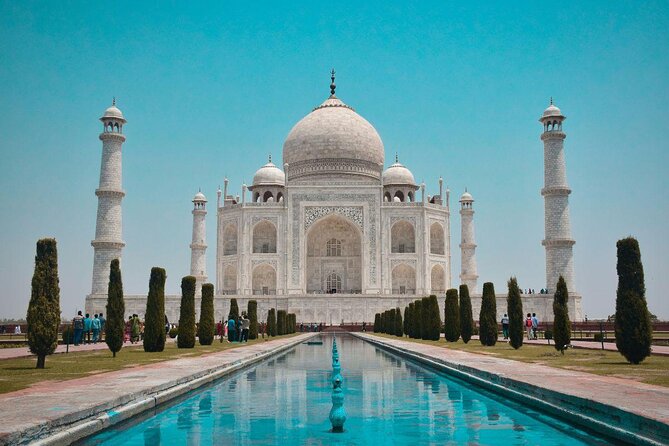
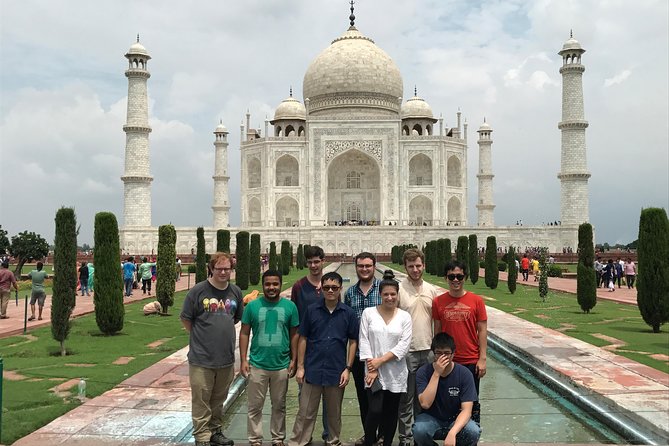
The Taj Mahal stop is the main event, and it is built for people who want meaning along with beauty. The white marble mausoleum was built in 1652 as a royal tomb for Mumtaz Mahal, commissioned by Emperor Shah Jahan. It took 20,000 workers about 22 years to complete, which is one of those facts that makes you look longer at the workmanship instead of just admiring the shape.
Here is what I think you should actively look for during your guided time:
- The domes, archways, and towers, and how they create depth even in a flat view
- The inlaid details and marble arcades close-up, where the pattern work becomes real
- The way the gardens act like a framing device, guiding your eyes between major buildings
This tour also promises a skip-the-line approach for the Taj Mahal visit. That is not just convenience. It can change your experience because it reduces waiting time, leaving more of your limited day for seeing.
What I like about having a guide here is the translation of symbolism. The Taj is not random decoration. It was designed as a love story turned into architecture, and your guide should be able to connect the story beats to what you are staring at.
Agra Fort: Mughal power in stone (and the Shah Jahan twist)
After the Taj, you go to Agra Fort, another UNESCO-listed site. This is a much more fortress-like setting, built by Emperor Akbar in the 16th century. It reflects a mix of architectural styles, including Hindu and central Asian influences.
The Fort is big, so a guided visit helps you avoid the classic problem: walking around with no idea what you are seeing. You can focus on courtyards, mosques, and chambers, but the story line is what makes it click. One highlight mentioned is the connection to Shah Jahan, including the idea that he was imprisoned by his son within view of the Taj.
That detail gives the Fort a strange emotional angle. You are standing inside a stronghold that represents rule and control, while the Taj sits as the monument of love and loss. Seeing both in one day helps you understand the Mughal world as something human, not just impressive geometry.
Practical note: inside time is listed at about 1 hour. That can be enough if you pick key stops with your guide. If you try to see everything solo, you can easily miss what matters most.
Itmad-ud-Daulah (Baby Taj): smaller scale, lots of precision

Then comes Itmad-ud-Daulah, often called the Baby Taj. It is located on the banks of the Yamuna and is a precursor to the larger Taj. The mausoleum dates to 1628 and was built by Empress Nur Jahan in memory of her father, Ghiyas Beg.
This stop is only about 30 minutes on paper, so it is the kind of place where you want a guide to point you to the best elements fast. The building is known for artistic detail in white marble, including trellises and precious-stone-like inlay work. You also get design influences described as Persian in style, which helps you understand why it feels related to the Taj but not identical.
What I like about fitting Baby Taj into the day is variety. The Taj is grand and heavy on scale. Itmad-ud-Daulah is more intimate. It feels like the craft work is the main character. If the Taj is the headline, Baby Taj is the supporting paragraph that makes the writing clearer.
You can also read our reviews of more tours and experiences in New Delhi





Mahtab Bagh at sunset: the Taj view most people skip
The last stop is Mahtab Bagh, also called the Moonlight Gardens. It sits across the Yamuna from the Taj Mahal, and the big promise is sunset viewing as dusk falls.
This is smart for two reasons. First, it adds a time-based experience. The Taj changes as the light shifts, and a second viewing angle makes the monument feel new again. Second, it gives you a break from the inside-only rhythm. By the time you reach Mahtab Bagh, you have already spent hours looking at marble details up close and in fort courtyards. A riverside moment slows you down.
The tour description includes going inside at this stage as the sun sets, with your view focused on the main Taj across the river. Even if you are not a hardcore photographer, this is where the day often becomes memorable. You start to connect the earlier stops into one bigger story.
Price and value: what $5 can realistically mean for you
The price shown is $5 per person, which is unusually low for a private day trip with hotel pickup, private transport, and guided visits. I cannot tell you what you should assume, because the real value depends on what is included when you book.
Here is what your planning should focus on based on the provided details:
- Hotel pickup and drop-off are included
- Private transport is included
- You get a professional guide for high-value tickets
- Monument entrance fees are listed as not included
- Lunch and drinks are not included
- A mobile ticket is offered
- Group discounts exist
So the most practical way to judge value is this: if you are paying entry fees and still want a pre-arranged private guide day, this can be a strong deal. If you plan to skip guides and entrance planning, the math changes.
Also keep in mind the smart-casual dress code. It is not a big deal, but it can affect what you wear on a hot day when you also need comfortable shoes.
One more thing: the tour requires passport name, number, expiry, and country at booking for all participants. That is common for India sightseeing, but you should have your passport details ready so the day stays smooth.
Tickets, lunch, and the money decisions that affect your day
You should budget for entrance fees even though the stops show admission tickets in some parts of the day plan. The safest approach is to treat entry fees as a cost you may have to pay directly at the monuments unless you confirm otherwise in advance.
Lunch is also explicitly an own expense break. That is normal on a long day trip, and it gives you a choice: you can eat quickly to protect your sightseeing time, or you can slow down if your group pace allows it.
What you should do to make this easy:
- Carry small cash for meals and any on-the-ground purchases
- Keep water handy, especially for the travel and walking time
- Wear clothing that matches smart casual and also works with heat
Because the day is long, small delays add up. If you plan for payments and food early, you keep the itinerary in motion.
Who should book this Taj Mahal luxury-style private tour
This tour fits best if you want structure. If you like knowing what you are seeing, and you want a plan that includes the Taj, Red Fort, Baby Taj, and a sunset viewpoint in one day, it is a good match.
It also fits well if you are traveling with people who need help making sense of the sites. The Taj Mahal is famous, but it can feel like a blur if you only read plaques. With guided context and practical pacing, the experience becomes easier to remember.
I would also consider it if you want a more controlled group environment. The cap of 16 and the fact that it is private for your group helps reduce the chaos that comes with large group bus tours.
Where it may not fit is if you prefer to roam slowly without a set sequence. This is a full-day plan with set stops and defined time blocks. You will get a lot packed in, which is great if you want that. It is less ideal if you want long unplanned breaks.
Quick practical advice for your day in Agra
For a full-day Agra run, your biggest enemies are heat, fatigue, and standing around waiting. This tour solves some of that with private transport and guide support, but you still want to show up ready.
Bring or plan for:
- Comfortable walking shoes, because you will move between courtyards and viewpoints
- A light layer for indoor areas where air-conditioning can feel strong
- Sunscreen and a hat, even if your schedule includes shade
- Patience for crowds at major landmarks, even when a skip-the-line approach is promised
And mentally, shift your expectation. The goal is not to collect every angle forever. The goal is to understand the story line: Taj as love and marble craft, Fort as power and imprisonment, Baby Taj as precursor artistry, and Mahtab Bagh as the Taj in changing light.
Should you book? My take
Book it if you want a structured Agra day with a guide, private transport, and the important sunset viewpoint across the Yamuna. It is especially appealing if your group has limited time and you want the Taj, Agra Fort, and Baby Taj to feel connected instead of separate checkboxes.
Skip it or at least confirm details first if your budget is tight and you do not want extra costs for entrance fees. With a long day and food on your own, you should plan a realistic spending amount beyond the advertised price.
If you do book, I would make one move before you go: confirm what entrance fees are covered for the monuments you will enter. That simple check can save you stress at the gate and keep the day feeling easy.
FAQ
FAQ
How long is the Agra day trip from Delhi?
The duration is listed as approximately 14 hours, including travel time and all scheduled sightseeing stops.
Does the tour include hotel pickup and drop-off in Delhi?
Yes. Delhi hotel pickup and drop-off are included.
Is transportation private and air-conditioned?
Yes. You travel by private, air-conditioned vehicle.
Is the tour only for my group?
Yes. It is described as a private activity, so only your group participates.
What are the main sightseeing stops during the day?
You will visit the Taj Mahal, Agra Fort, Itmad-ud-Daulah (Baby Taj), and you will have sunset views from Mahtab Bagh (Moonlight Gardens).
Are entrance fees included?
Entrance fees of monuments are listed as not included.
Is lunch included?
No. There is a break for lunch in Agra, but lunch is an own expense.
What is the maximum group size per booking?
The maximum is 16 people per booking.
Do I need passport details when booking?
Yes. You are asked for passport name, number, expiry, and country for all participants.
What is the cancellation policy?
Free cancellation is available up to 24 hours in advance for a full refund.